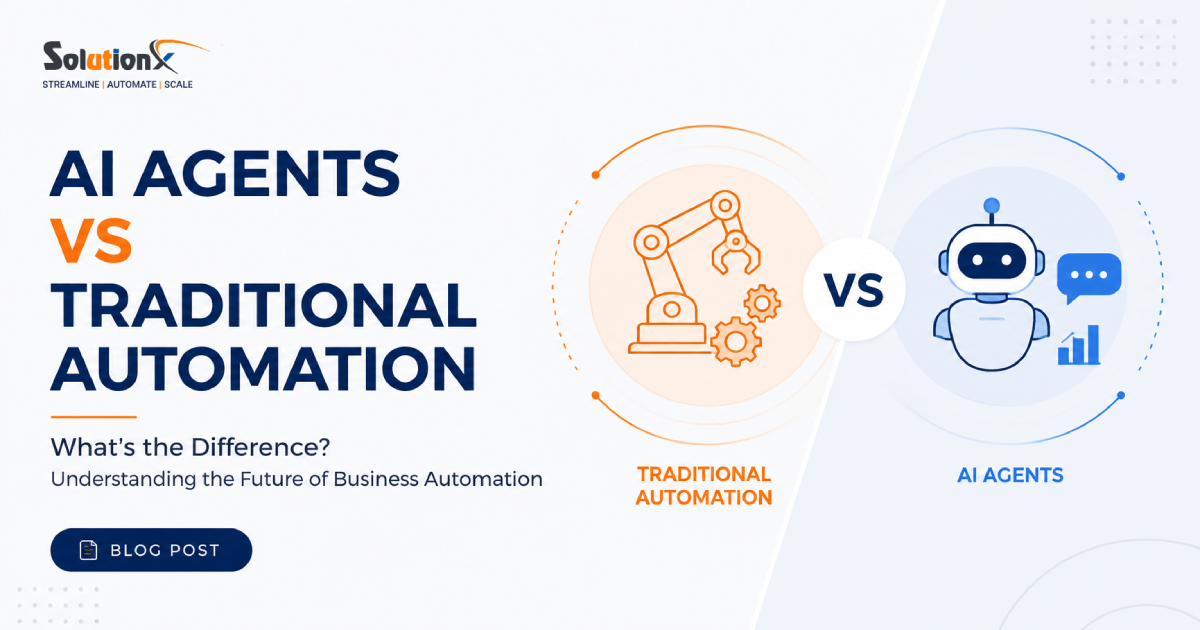
AI Agents vs Traditional Automation: What's the Difference?
Businesses have relied on automation for decades to eliminate repetitive tasks and improve efficiency. From automated email responses to workflow triggers and scheduled reports, traditional automation has become an essential part of modern operations.
However, the rise of Artificial Intelligence has introduced a new concept: AI Agents.
Unlike traditional automation systems that follow predefined rules, AI agents can understand context, make decisions, learn from data, and take actions autonomously. As organizations explore AI-powered solutions, understanding the difference between AI agents and traditional automation is critical for making the right technology investments.
What Is Traditional Automation?
Traditional automation refers to systems that execute predefined actions based on fixed rules and conditions.
For example:
Sending an email when a form is submitted
Creating a CRM record after receiving a lead
Generating monthly reports automatically
Syncing data between applications
These systems are highly effective for repetitive and predictable tasks because they follow a clear set of instructions.
Key Characteristics
Rule-based
Predictable outcomes
Requires predefined workflows
Limited decision-making capabilities
Fast and reliable for structured processes
What Are AI Agents?
AI agents are intelligent software systems capable of perceiving information, making decisions, and taking actions to achieve specific goals.
Instead of simply following rules, AI agents analyze context and determine the most appropriate action.
Examples include:
AI customer support agents
Sales assistants that qualify leads
Intelligent scheduling assistants
AI-powered research agents
Automated data analysis systems
These agents use technologies such as machine learning, large language models, and natural language processing to operate more independently.
Key Characteristics
Context-aware
Goal-oriented
Adaptive behavior
Natural language understanding
Autonomous decision-making
Traditional Automation vs AI Agents
Decision Making
Traditional automation follows predefined logic.
Example:
If a customer submits a form, create a CRM contact.
AI agents evaluate context before deciding.
Example:
Analyze the inquiry, identify customer intent, prioritize urgency, and assign it to the appropriate team member.
Flexibility
Traditional automation struggles when unexpected situations occur.
AI agents can adapt to changing inputs and handle more complex scenarios without extensive manual configuration.
Learning Capability
Traditional automation does not learn from previous actions.
AI agents can improve performance over time through feedback, training, and data analysis.
Human Interaction
Traditional automation typically relies on structured inputs.
AI agents can communicate naturally with users through conversations, emails, and documents.
When Traditional Automation Is the Better Choice
Traditional automation remains the best solution for:
Repetitive workflows
Data synchronization
Scheduled tasks
Form processing
Simple notifications
Approval workflows
These processes are predictable and do not require complex decision-making.
When AI Agents Are the Better Choice
AI agents excel when businesses need:
Intelligent customer support
Lead qualification
Document analysis
Research and information gathering
Personalized communication
Complex decision-making
These tasks involve context, interpretation, and adaptability.
Real-World Business Examples
Customer Support
Traditional Automation:
A chatbot provides predefined responses based on keywords.
AI Agent:
An AI support agent understands customer intent, retrieves information, resolves issues, and escalates when necessary.
Sales Operations
Traditional Automation:
Every lead is assigned using fixed rules.
AI Agent:
Leads are scored, analyzed, and routed based on likelihood to convert.
Reporting
Traditional Automation:
Reports are generated on a schedule.
AI Agent:
Data is analyzed automatically, trends are identified, and recommendations are generated.
Can Businesses Use Both Together?
Absolutely.
The most effective automation strategies combine both approaches.
Traditional automation handles structured processes efficiently, while AI agents manage complex decision-making and communication tasks.
For example:
A website visitor submits a form.
Traditional automation creates a CRM record.
An AI agent analyzes the lead.
The AI agent qualifies the lead and recommends next steps.
The sales team receives prioritized opportunities.
This hybrid approach delivers maximum efficiency and intelligence.
Benefits of AI Agents
Reduced manual work
Faster response times
Improved customer experiences
Better decision-making
Increased operational efficiency
Enhanced scalability
Challenges to Consider
While AI agents offer significant advantages, businesses should consider:
Data quality requirements
Security and compliance
Initial implementation costs
Monitoring and governance
Integration with existing systems
Proper planning ensures successful adoption and long-term value.
Final Thoughts
Traditional automation remains an essential foundation for efficient business operations. However, AI agents represent the next evolution of automation by enabling systems to understand context, make decisions, and act autonomously.
Rather than replacing traditional automation, AI agents enhance it.
Organizations that successfully combine both technologies can improve productivity, reduce operational costs, and create more intelligent workflows that scale with business growth.
As AI continues to evolve, businesses that embrace intelligent automation today will be better positioned to compete in the future.

Pro SolutionX
Technology & Growth Team
Pro SolutionX is a team of software engineers, AI specialists, automation consultants, and digital growth experts dedicated to helping businesses scale through technology, custom software, AI automation, cloud infrastructure, and data-driven digital strategies.