
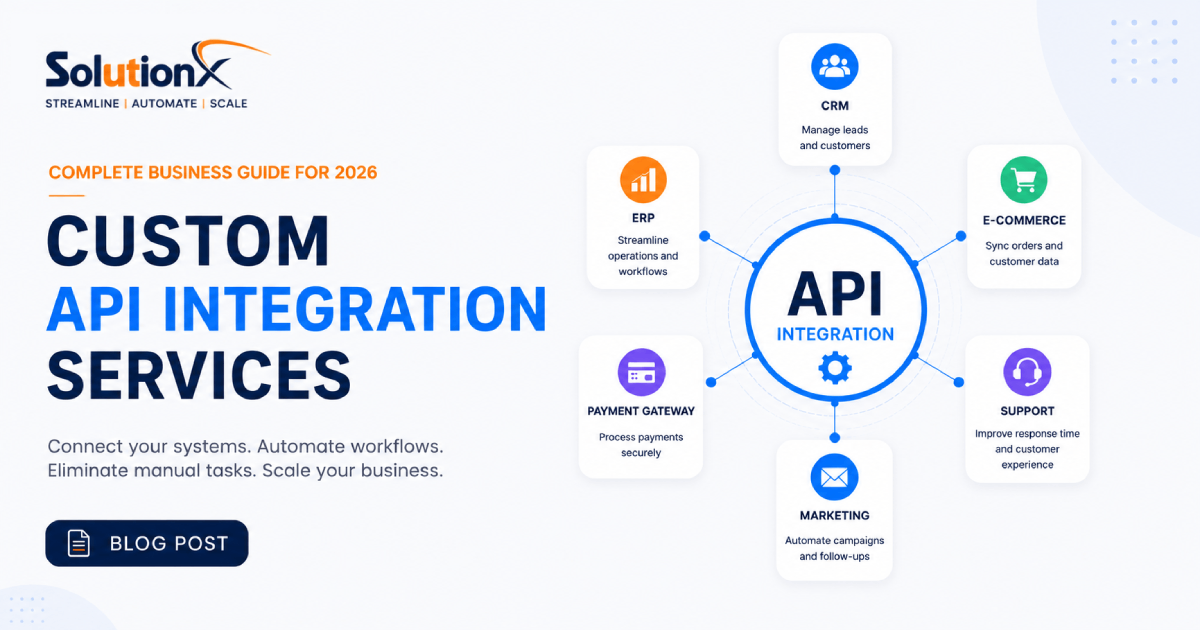
Custom API Integration Services: Complete Business Guide for 2026
Modern businesses rely on dozens of software tools to manage operations, customers, sales, finance, inventory, and communication. While these tools are powerful individually, they often create data silos that slow productivity and require manual work.
Custom API integration solves this problem by connecting software systems and enabling them to exchange data automatically.
In this guide, we'll explain what API integration is, why businesses need it, common use cases, challenges, and how to implement integrations successfully.
What Is API Integration?
API (Application Programming Interface) integration allows different software applications to communicate with each other.
Instead of employees manually transferring data between systems, APIs automate the process.
For example:
A new lead enters your website
The lead is automatically sent to your CRM
A sales task is created
A welcome email is triggered
Reporting dashboards update automatically
Everything happens without manual intervention.
Why Businesses Need API Integration
As businesses grow, they adopt more tools.
Common examples include:
CRM platforms
ERP systems
Payment gateways
Accounting software
Marketing automation tools
Customer support platforms
Inventory management systems
Without integration, teams spend valuable time copying information between systems.
API integration helps businesses:
Reduce manual work
Eliminate duplicate data entry
Improve data accuracy
Increase productivity
Scale operations efficiently
Common API Integration Use Cases
CRM Integrations
Connect website forms, marketing platforms, and sales systems directly to CRMs such as Salesforce, HubSpot, or Zoho.
Benefits:
Automatic lead capture
Faster follow-up
Better sales visibility
ERP Integrations
Integrate ERP systems with eCommerce stores, inventory tools, and accounting platforms.
Benefits:
Real-time inventory updates
Automated order processing
Improved financial reporting
Payment Gateway Integrations
Connect Stripe, PayPal, Razorpay, or other payment systems with internal applications.
Benefits:
Automated invoicing
Faster reconciliation
Improved customer experience
Marketing Automation
Connect CRMs with email marketing platforms.
Benefits:
Automated campaigns
Personalized customer journeys
Better lead nurturing
API Integration Challenges
Businesses often face several challenges when implementing integrations.
Data Mapping
Different systems store information differently.
Proper mapping ensures data remains accurate across platforms.
Authentication & Security
APIs require secure authentication methods such as:
OAuth 2.0
API Keys
JWT Tokens
Security should always be prioritized.
Rate Limits
Many APIs restrict request volume.
Integration architecture must account for these limitations.
Error Handling
Systems occasionally fail.
A robust integration includes:
Retry mechanisms
Logging
Monitoring
Alerting
Best Practices for Successful API Integrations
Understand Business Requirements
Start by identifying:
What systems need to connect
What data should flow
How frequently data should sync
Build for Scalability
Business requirements evolve.
Integrations should support future growth without major redevelopment.
Prioritize Security
Use encrypted communication, secure credentials, and proper access controls.
Monitor Continuously
Monitoring helps detect failures before they affect business operations.
How Custom API Integration Improves Automation
API integrations are the foundation of modern business automation.
Once systems are connected, organizations can automate:
Lead management
Customer onboarding
Billing processes
Reporting
Inventory management
Customer support workflows
This creates faster operations and better customer experiences.
Why Choose Custom API Integration Instead of Off-the-Shelf Connectors?
Platforms like Zapier and Make are useful for simple workflows.
However, growing businesses often require:
Complex logic
Custom data transformations
Enterprise-level security
High-volume processing
Multiple system integrations
Custom integrations provide greater flexibility, performance, and control.
Final Thoughts
Businesses today cannot afford disconnected systems and manual processes.
Custom API integration enables organizations to streamline operations, improve data accuracy, and create scalable automation workflows.
Whether you're connecting CRMs, ERPs, payment gateways, or custom applications, a well-designed integration strategy can significantly improve efficiency and support long-term growth.
If your business relies on multiple software platforms, investing in custom API integration can be one of the highest-impact improvements you make in 2026.

Pro SolutionX
Technology & Growth Team
Pro SolutionX is a team of software engineers, AI specialists, automation consultants, and digital growth experts dedicated to helping businesses scale through technology, custom software, AI automation, cloud infrastructure, and data-driven digital strategies.